Contractibility and Asset Ownership: On-Board Computers and Governance in U. S. Trucking

Contractibility and Asset Ownership: On-Board Computers and Governance in U. S. Trucking
Authors: George P. Baker, Thomas N. Hubbard
Citation: Baker, George P. and Hubbard, Thomas N. (2004). Contractibility and Asset Ownership: On-Board Computers and Governance in U. S. Trucking. The Quarterly Journal of Economics, 119(4), 1443--1479.
Abstract: We investigate how contractual incompleteness affects asset ownership in trucking by examining cross-sectional patterns in truck ownership and how truck ownership has changed with the diffusion of on-board computers (OBCs). We find that driver ownership of trucks is greater for long than short hauls, and when hauls require equipment for which demands are unidirectional rather than bidirectional. We then find that driver ownership decreases with OBC adoption, particularly for longer hauls. These results are consistent with the hypothesis that truck ownership reflects trade-offs between driving incentives and bargaining costs, and indicate that improvements in the contracting environment have led to less independent contracting and larger firms.
Reading Notes
Objective
To determine whether incompleteness of contracts determines who owns an asset in an industry by looking at the US Trucking industry before and after the introduction of onboard computers
Background
Two incentive issues: how the truck is driven, incompleteness of contracts for which loads will be carried
Owner-operators are more likely to take better care of their trucks than company trucks
Data & Key Variables
Truck-level data from the Census Bureau 1987 and 1992 Truck Inventory and Use surveys
Type of trailer (backhaul vs non backhaul), average distance traveled, ownership, OBC adoption rates, type of OBC
Methodology
Truncated logit to test if company owned trucks are more likely to use OBCs
The second estimate uses the difference in the log odds ratio of shares of owner-operated versus company owned in 1992 and 1987 and compares the change in OBC use for difference characteristics
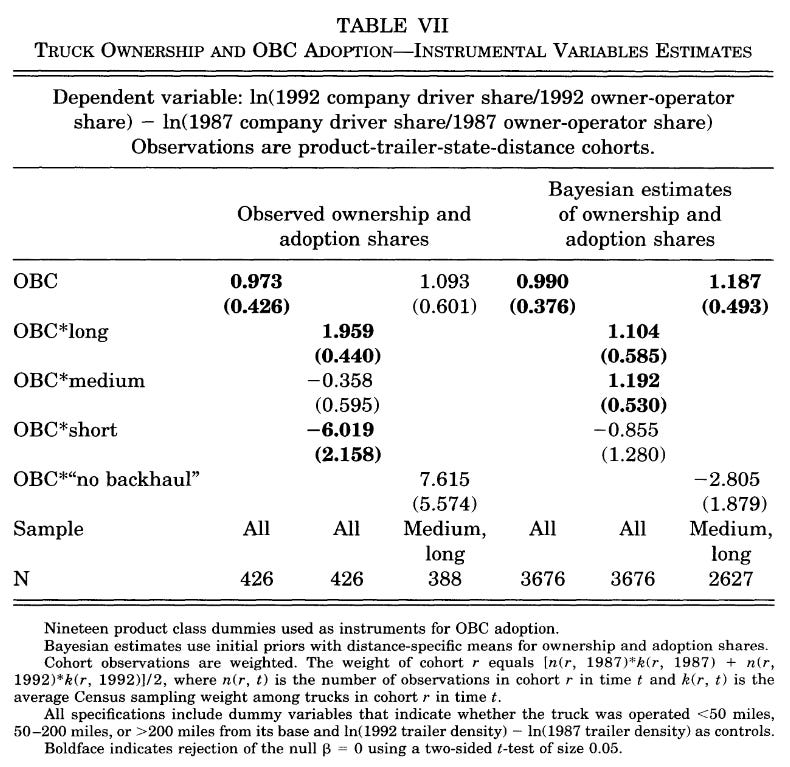
Finally instrumental variables to control for endogeneity in OBC adoption, and compare results for different types of OBCs
Results
Driver ownership is greater for long hauls and for no backhaul hauls
Driver ownership decreases with OBC adoption, and this relationship is strongest for long hauls
OBCs also seem to improve the average fuel economy for trucks
Key Table/Figure