
Demographic Differences in Letters of Recommendation for Economics Ph.D. Students
Authors: Beverly Hirtle, Anna Kovner
Abstract: We analyze 6,400 letters of recommendation for more than 2,200 economics and finance Ph.D. graduates from 2018 to 2021. Letter text varies significantly by field of interest, with significantly less positive and shorter letters for Macroeconomics and Finance candidates. Letters for female and Black or Hispanic job candidates are weaker in some dimensions, while letters for Asian candidates are notably less positive overall. We introduce a new measure of letter quality capturing candidates that are recommended to “top” departments. Female, Asian, and Black or Hispanic candidates are all less likely to be recommended to top academic departments, even after controlling for other letter characteristics. Finally, we examine early career outcomes and find that letter characteristics, especially a “top” recommendation have meaningful effects on initial job placements and journal publications.
Seminar Notes
Venue
ASSA 2026
Objective
To understand how the strength of recommendation letters for economics PhD students vary by gender and race
Importance
Previous work on bias in letters of recommendation focus solely on gender differences, not race/ethnicity
Background
Letters are important for conveying soft information, but not standardized
Data & Key Variables
Around 6,400 recommendation letters for 2,227 new PhD candidates.
Candidate-provided information on gender and race
Letter writers’ gender and race (Asian/not Asian) from name matching
Methodology
Natural Language Processing - letter length, identify “standout” and “grindstone” words - the former are high praise, the latter focus on effort
Flag candidates recommended to a “top” economics or finance department
Results
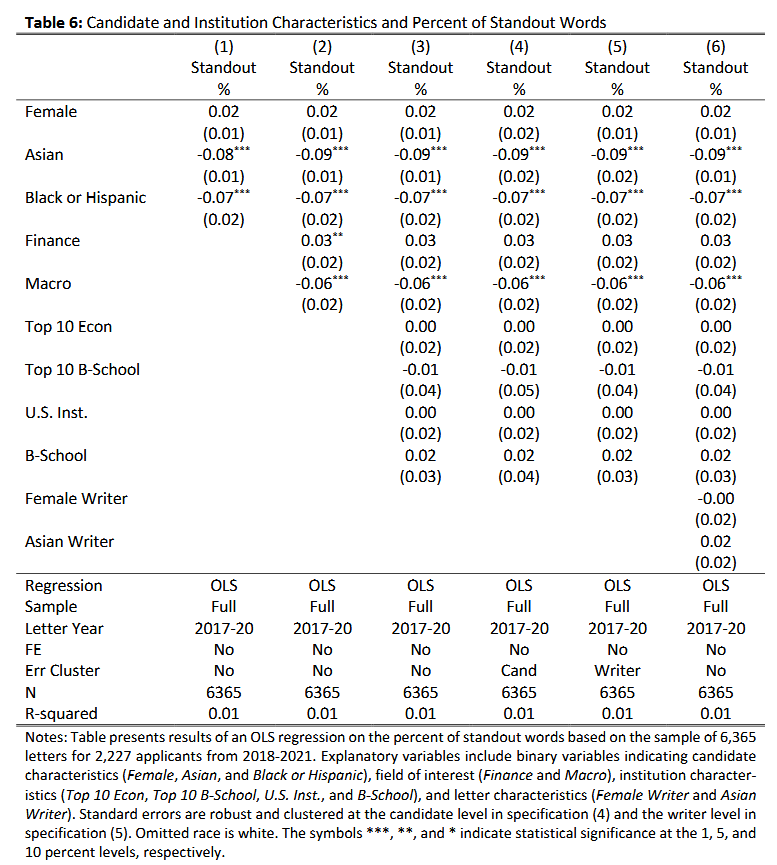
Meaningful difference in strength of recommendation by gender and race/ethnicity, with weaker letters (lower share of standout words) for women, Black, Hispanic and Asian candidates relative to White male students
Pairing of female candidates with female letter writers explain lower likelihood of being recommended to a top program. Bias against Asian candidates not explained by the characteristics of the recommender
Key Table/Figure
Whoa.