Does early timing of first birth lead to lower earnings in midlife in Britain?
Authors: Jessica Nisén, Johanna Tassot, Francesco Iacoella, Peter Eibich
Citation: Nisén, Jessica and Tassot, Johanna and Iacoella, Francesco and Eibich, Peter (2025). Does early timing of first birth lead to lower earnings in midlife in Britain?. Journal of Family Research, 37(), 373--394.
Abstract: Objective: To examine the effect of the timing of a woman’s first birth on her midlife earnings, and the potential mediators of this effect. Background: While many studies demonstrate that motherhood substantially affects women’s wages and earnings, there is less research on the impact of the timing of entry into motherhood, particularly in the long term and in contexts outside the US. Method: We analysed data on women who gave birth for the first time between the ages of 15 and 30, taken from the 1970 British Cohort Study. Within the framework of instrumental variable regression, our preferred specification utilised the occurrence of contraceptive failure as a source of exogenous variation in the age at first birth. Results: We found tentative evidence that a higher age at first birth led to a higher probability of being employed in midlife. At the same time, a higher age at first birth reduced the earnings level of employed mothers in midlife. This was because a later first birth often resulted in mothers working part time rather than full time. Furthermore, a higher age at first birth decreased the time until the second birth, while increasing the probability of having a co-resident partner who could contribute to the household income. Conclusion: These findings suggest that the impact of having an early first birth on earnings in midlife is not uniformly negative.
Reading Notes
Objective
To understand how the timing of first birth affects women’s labor market outcomes
Importance
Existing studies on the effect of age at first birth on labor market outcomes mostly use US data, but age at first birth has increased less in the US than in other countries
This paper measures earnings at midlife, rather than shortly after birth, which differs from most of the literature
Background
Early childbearing can interrupt education or human capital accumulation at work.
Timing of childbirth can also affect occurrence or timing of subsequent births
Data & Key Variables
1970 British Cohort study - follows lives of over 17,000 British residents born in same week of 1970
Sample includes women who reported a first birth by the Age 30 survey.
Earnings measured at age 46.
Methodology
IV using contraceptive failure & biological fertility shocks (miscarriage)
Dummy for if first child was conceived despite using contraception at time of conception
Controls for education, years spent in paid work, family size and birth spacing, parental background, region
Results
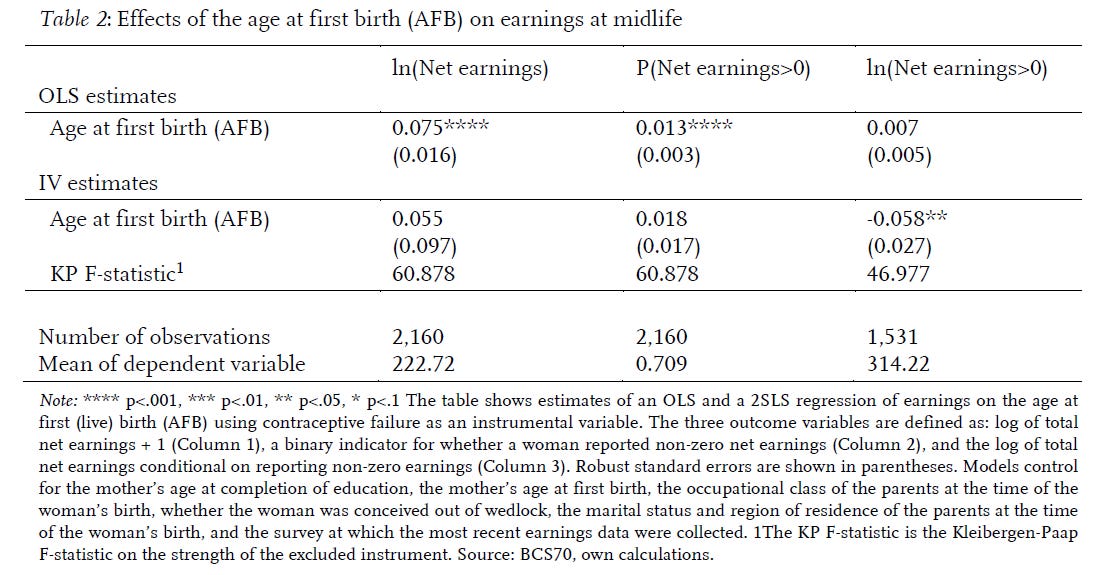
A one year delay in age at first birth increases earnings at midlife by 7.5%, primarily driven by the probability of working part time versus full time, which is, in turn, potentially driven by presence of co-residential partner
Key Table/Figure