Earnings Instability

Earnings Instability
Authors: Peter Ganong, Pascal J. Noel, Christina Patterson, Joseph S. Vavra, Alexander Weinberg
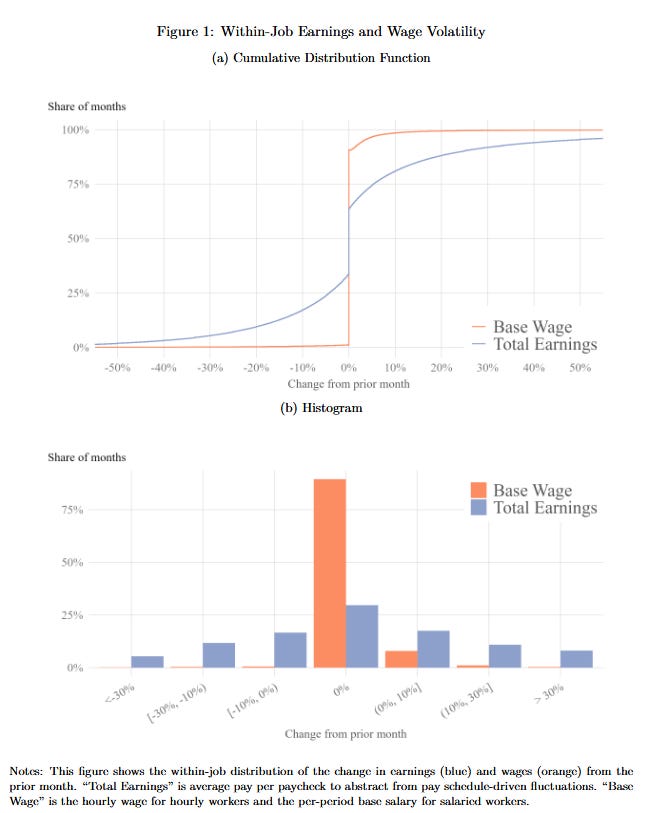
Abstract: This paper uses high-frequency administrative data to show that the majority of U.S. workers experience substantial month-to-month fluctuations in pay, even within ongoing employment relationships. This earnings instability is pervasive, but it has been masked in past analysis of annual data. Moreover, this instability is unequally distributed: lower-income, hourly workers face more instability than higher-income, salaried workers. This is because earnings instability arises in large part from firm-driven fluctuations in hours. This earnings instability is a meaningful source of economic risk: we provide causal evidence that it increases consumption volatility and also leads to greater job separations, and we find that workers have a high willingness to pay to reduce earnings instability. These findings suggest that short-term earnings risk is a significant and previously underappreciated feature of the labor market.
Seminar Notes
Objective
Does stable employment mean workers have stable earnings from month to month?
Importance
Most evidence on employment and earnings comes from annual data - doesn't capture volatility, intensive/extensive margin.
Background
65% of Americans are living paycheck to paycheck. 92% of Americans would choose financial stability over larger paycheck
Data & Key Variables
Paycheck-level data from large payroll processing company. Serves primarily small firms (<100 employees). Around 500,000 firms.
Paycheck level earnings and hours - gross pay per paycheck, components (base pay, bonuses)
Job spell ends when worker has >2 months of zero pay
Supplemental data sources: JP Morgan Chase microdata, SIPP
Results
Monthly standard deviation of earnings >=31%. Hours fluctuations are a large source of earnings instability
High-frequency labor market shocks within employment are important and hidden in annual earnings data
Comments
Biweekly paychecks cause volatility in LEHD data - so hard to look at this with LEHD data
Key Table/Figure