Financial Incentives to Fertility: From Short to Long Run
Authors: Lidia Cruces, F Javier Rodrıguez-Roman
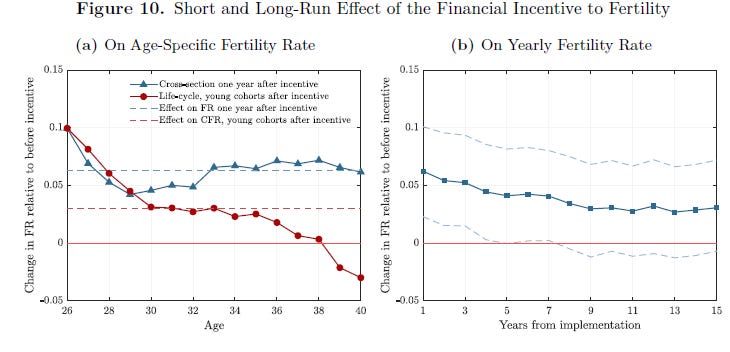
Abstract: In this paper, we integrate available empirical evidence on the short-term effects of financial incentives to fertility with a dynamic life-cycle model featuring labor force participation and birth decisions to simulate long-term effects. We first discuss, in a simple model, why these can differ: while short-run effects arise from fertility decision adjustments by women of different ages during incentive implementation, long-run effects depend on women’s responses with access to incentives throughout their fertile years. Then, we extend the model to a comprehensive life-cycle framework that captures the intricate trade-offs between career and family choices, and calibrate the parameters to match the short-run responses from a real policy in Spain. We find that the magnitude of the long-run effects is half that of the short-run effects (3% vs. 6%).
Seminar Notes
Venue
SOLE 2024
Objective
How effective are pro-natalist policies in increasing fertility?
Importance
Limited empirical evidence on pro-natalist policies on total fertility
Background
Total fertility rate < 2.1 - population aging, declining
Cheque bebe - July 3, 2007.
2500 euro one time cash payment per newborn baby - coverage and takeup nearly universal
Data & Key Variables
Lifecycle age 25-51
Women make labor supply & fertility decisions (up to 3 children)
Probability of infertility, increasing with age
Children are costly and cost varies with child age
Methodology
Quantitative dynamic lifecycle model of labor force participation and fertility.
Can have child in period 1 (early child) period 2 (late child) or no child
Calibrate to Spain’s “cheque bebe” program.
Simulated method of moments
Results
Long run effect of cash transfers on fertility is around 1/2 of short run effects
Key Table/Figure