Gender Convergence in Couples’ Time Use Following the COVID-19 Pandemic

Gender Convergence in Couples’ Time Use Following the COVID-19 Pandemic
Authors: Ariel Binder
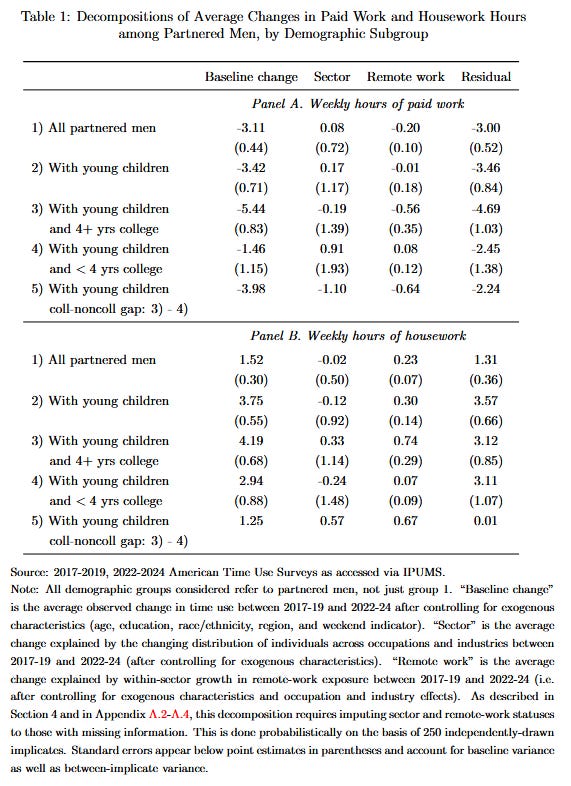
Abstract: This paper uses American Time Use Survey to show that prime-age men’s and women’s average weekly work hours followed parallel trends from 2011-19, but then abruptly converged in the years following the COVID-19 pandemic. This convergence was driven by the changing behavior of couples, for whom the gender gap in weekly hours of paid work closed by 4.3 on a base of 14.7 (29.3%). While historical gender convergence has been driven by wives, husbands accounted for three-quarters (all) of the recent convergence in paid work (unpaid housework). I find that two labor market factors associated with the pandemic—sectoral reallocation and remote work-exposure—explain little of observed time-use changes in samples of husbands and fathers, although they explain 44% of the shrinking college-noncollege gap in paid work observed among fathers. These results suggest an ongoing shift in labor supply factors associated with fatherhood that may be stronger among the college-educated.
Seminar Notes
Venue
CES Brownbag 2026
Objective
To understand how time use on paid work and housework has changed in the post-pandemic period relative to pre-pandemic by gender
Importance
Reasons to expect lasting effect of the pandemic: shifting household preferences, expansion of work from home
Background
Quiet Revolution - convergence in gender roles/earnings through the 20th century, but slower more recently
COVID-19 recession affected women’s labor market more, unlike previous recessions, but faster recovery. Women’s employment fully recovered by end of 2021
Data & Key Variables
American Time Use Survey linked to CPS
Prime age 25-54
Pre-pandemic (2017-19) versus post-pandemic (2022-24)
4 categories: Paid work, housework, work-related travel, the REST (Relaxation, Entertainment, Sleep, TLC/Personal Care)
Methodology
Descriptive graphs
Decomposition framework (Gelbach (2016))
Remote work = 30+ minutes of work and 0 minutes commuting
Results
Gender gap closure in work hours of 8.4 percentage points relative to pre-pandemic. Growth in female hours and decline in male hours. Approximately the same for those with and without children
Gender gap in housework has declined for those with children.
Shift in paid work larger for more educated parents with young children
Key Table/Figure