How should inmates be released from prison? An assessment of parole versus fixed-sentence regimes

How should inmates be released from prison? An assessment of parole versus fixed-sentence regimes
Author: Ilyana Kuziemko
Abstract: Over the past 30 years, many states have abolished parole boards, which traditionally have had the discretion to release inmates before the expiration of their full sentence, in favor of fixed-sentence regimes in which the original sentence is binding. However, if prison time lowers recidivism risk and if parole boards can accurately estimate inmates’ recidivism risk, then relative to a fixed-sentence regime, parole can provide allocative-efficiency benefits (costly prison space is allocated to the highest-risk offenders) and incentive benefits (prisoners know they must reduce their recidivism risk to gain an early release, so invest in their own rehabilitation). Exploiting quasi-experiments from the state of Georgia, I show that prison time reduces recidivism risk and that parole boards set prison time in an allocatively efficient manner. Prisoners respond to these incentives; after a reform that eliminated parole for certain offenders, they accumulated a greater number of disciplinary infractions, completed fewer prison rehabilitative programs, and recidivated at higher rates than inmates unaffected by the reform. I estimate that eliminating parole for all prisoners would increase the prison population by 10% while also increasing the crime rate through deleterious effects on recidivism.
Date: 2013-02-01
URL: https://academic.oup.com/qje/article/128/1/371/1840582
Volume: 128
Pages: 371-424
Publication: The Quarterly Journal of Economics
Issue: 1
Reading Notes:
Objective: To understand the effect of abolishing parole boards and switching to fixed-sentence regimes
Importance: There is a tradeoff between allocation of costly prison space and reducing crimes committed by released prisoners.
The promise of shorter prison sentences for those least likely to recidivate also incentivizes rehabilitation programs and good behavior in prison
Background: Parole boards fell out of favor in the 70s. In 2009 only 1/4 of prisoners were released at parole board discretion
Data & Key Variables: Georgia Department of Corrections data 1993-2011
Recidivism = return to prison within 3 years w/ new sentence
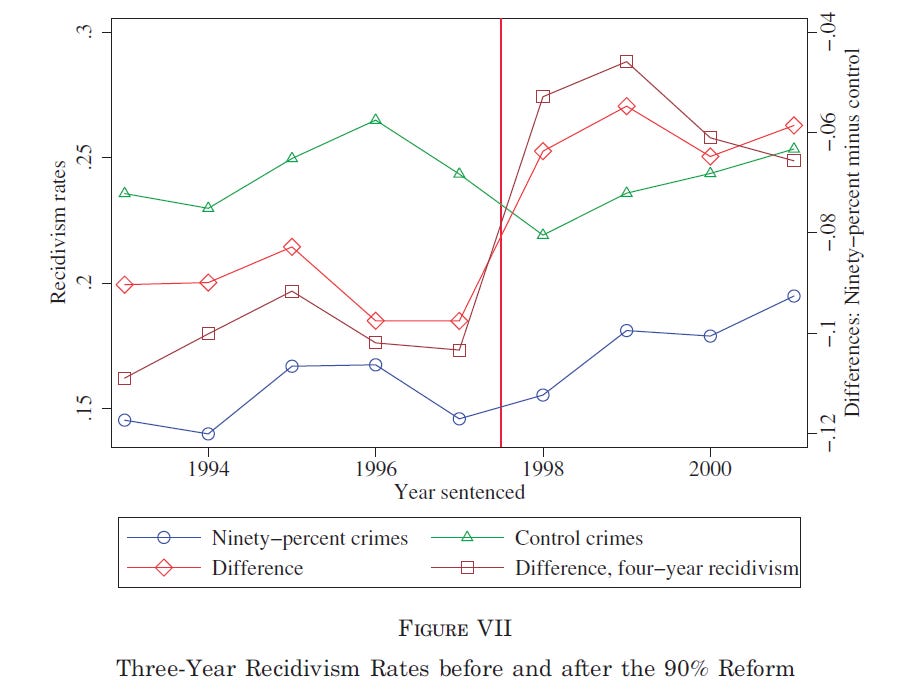
Offense type - 90% offenders serve at least 90% of sentence after 1997 reform
Within-prison variables: infractions and prison program participation
Methodology:
Time served & recidivism analysis - variation from mass release in 1981 which creates separation between recommended time and actual time served
Parole vs fixed sentence analysis - variation from 1997 reform that required a subset of prisoners to serve at least 90% of their sentence, based on offense type
Results: An extra month of prison reduces recidivism risk within 3 years of release by 1.3 percentage points
Inmates not eligible for parole had higher recidivism rates, more disciplinary actions in prison, and were less likely to complete rehabilitative programs
Key Table/Figure: