Increasing Residual Wage Inequality: Composition Effects, Noisy Data, or Rising Demand for Skill?

Increasing Residual Wage Inequality: Composition Effects, Noisy Data, or Rising Demand for Skill?
Authors: Thomas Lemieux
Citation: Lemieux, Thomas (2006). Increasing Residual Wage Inequality: Composition Effects, Noisy Data, or Rising Demand for Skill?. American Economic Review, 96(3), 461-498.
Abstract: This paper shows that a large fraction of the 1973-2003 growth in residual wage inequality is due to composition effects linked to the secular increase in experience and education, two factors associated with higher within-group wage dispersion. The level and growth in residual wage inequality are also overstated in the March Current Population Survey (CPS) because, unlike the May or Outgoing Rotation Group (ORG) CPS, it does not measure directly the hourly wages of workers paid by the hour. The magnitude and timing of the growth in residual wage inequality provide little evidence of a pervasive increase in the demand for skill due to skill-biased technological change. (JEL J31)
Reading Notes
Objective
To provide a better measure of residual wage inequality and show that it is inconsistent with skill-biased technical change
Importance
Measuring residual wage inequality using the May/ORG CPS data doesn’t have some of the problems that come from using the March CPS supplement and accounts for composition effects
Background
Residual wage inequality: wage inequality that cannot be explained by standard human capital variables like experience and education
Changes in residual wage inequality can only be interpreted as evidence of change skill prices if the distribution of unobserved skills and variance of measurement error are constant over time
Data & Key Variables
May/ORG CPS data - 1979-2003
Dual jobs supplement 1973-1978
Hourly wage rate, experience, educational attainment
Methodology
Based on Mincer equation w_it = x_it b_t + epsilon_it where x_it are observable skills epsilon_it = rho_t e_it + nu_it where e_it are unobservable skills
Results
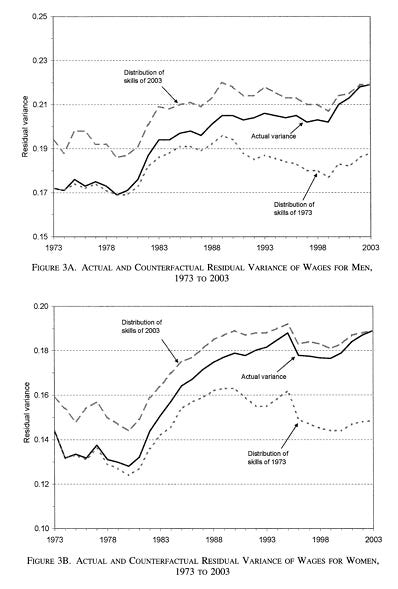
Residual wage inequality only accounts for a modest share in the growth in overall inequality. Growth in inequality concentrated in the 1980s.
College-educated workers have experienced both the greatest in residual inequality and the greatest relative wage growth
No sign of skill biased technical change in residual inequality growth
Key Table/Figure