Increasing the Demand for Workers with a Criminal Record
Authors: Zoë Cullen, Will Dobbie, Mitchell Hoffman
Citation: Cullen, Zoë and Dobbie, Will and Hoffman, Mitchell (2023). Increasing the Demand for Workers with a Criminal Record. The Quarterly Journal of Economics, 138(1), 103--150.
Abstract: We experimentally test several approaches to increasing the demand for workers with a criminal record on a nationwide staffing platform by addressing potential downside risk and productivity concerns. The staffing platform asked hiring managers to make a series of hypothetical hiring decisions that affected whether workers with a criminal record could accept their jobs in the future. We find that 39% of businesses in our sample are willing to work with individuals with a criminal record at baseline, which rises to over 50% when businesses are offered crime and safety insurance, a single performance review, or a limited background check covering just the past year. Wage subsidies can achieve similar increases but at a substantially higher cost. Based on our findings, the staffing platform relaxed the criminal background check requirement and offered crime and safety insurance to interested businesses.
Reading Notes
Objective
To understand why employers seek to do background checks on potential employees and what policy/information interventions would increase their willingness to hire a person with a criminal record
Importance
The average unemployment rate of formerly incarcerated people is high, 27% (Coulote & Kopf 2018).
Ban the box policies are meant to increase hiring, but have unintended consequences and may not help if employers do background checks later in the hiring process
Background
The Federal Work Opportunity Tax Credit offers a 25-40% wage subsidy, depending on how many hours worked.
The U.S. Federal Bonding Program offers an insurance bond of $5000 against liability for minor crimes
Data & Key Variables
Large nationwide staffing platform
Entry-level jobs. Job listings hosted on internet/app.
Jobs do not generally require college degree or prior experience. Job requests include job description, pay & qualifications.
Job matches are made by the platform, employers pay a cancellation fee if they cancel an accepted job
Hiring manager rates employees: overall, timeliness, cooperation, quality of work
Methodology
Field experiment
Baseline - ask if willing to hire individuals with a criminal record. No subsidy (1/5), wage subsidy (4/5 with different percentage of total wage)
Offered randomly assigned insurance level, with same level of subsidy & asked again if willing to hire individuals w/ criminal record.
Also offered information/exclusions based on: performance history or criminal history (years since conviction)
Results
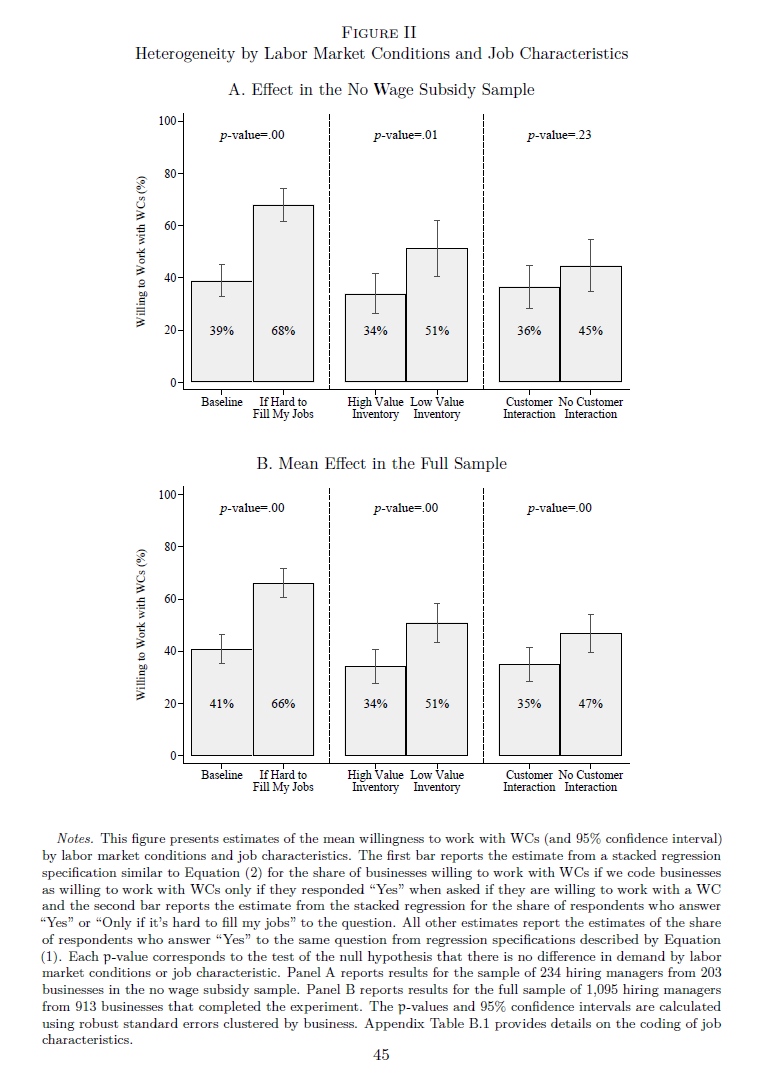
39% of businesses are willing to hire someone with a criminal record at baseline.
Higher at non-customer facing (45%), jobs without high-value inventory (51%), and businesses struggling to fill positions (68%)
Willingness increases by 10% with offer of crime & safety insurance, a positive performance review, or no arrests/convictions in last year.
This is similar to the effect of, and less expensive than, a 80% wage subsidy
Comments
Experiment run during March and April 2020. Unfortunate timing. Probably needs a follow up to understand external validity.
Key Table/Figure