Internal Versus Institutional Barriers to Gender Equality: Evidence from British Politics

Internal Versus Institutional Barriers to Gender Equality: Evidence from British Politics
Authors: Noor Kumar, Uyseok Lee, Matt Lowe, Olaitan Ogunnote
Abstract: Weekly lotteries determine which politicians ask the UK Prime Minister a question in front of a male-dominated, noisy chamber. Lottery winners receive 4% higher vote margin in the next election, but women are 12% less likely to submit questions than same-cohort men. The gender gap does not close with lottery-induced experience asking a question, but it closes after a format change, with questions asked to a smaller, quieter audience. The switch differentially draws in women with quieter voices. Our findings support institutional change, rather than experience, as a response to gender gaps in adversarial settings like the UK Parliament.
Seminar Notes
Venue
SITE Gender 2023
Objective
To understand if women can adapt to adversarial work culture or if work culture changes over time as women join the profession
Importance
Work culture could effect women in two ways: Women could be treated the same as men, but are put off more by the culture. Women could also be treated worse than men
Background
Prime Minister’s questions in the UK. Women are less likely to ask questions than men.
Prime minister answers 6 questions from Opposition Leader then 15 from MPs selected by lotteries (computer called “Shuffle”). About 50% of MPs submit each week
Data & Key Variables
157 lotteries from May 2015-March 2020 - lottery entrants and winners
Past winners sample - 1990-2005 (no info on who submitted, just lottery winners)
MP characteristics - gender, cohort, party, age, vote margin, posts
2,236 question-answer exchanges coded - issue, interruptions, humor, etc
Methodology
Natural experiment - weekly lotteries determine who asks a question/who gains experience
Do those who ask a question in one week enter subsequent lotteries?
COVID19 change format to hybrid
Results
Women are 12% less likely to submit question. This gap persists over 1990-2020, while female representation amongst MPs has grown
The gender gap does not close with personal experience
Women are 3x more likely to be interrupted than men
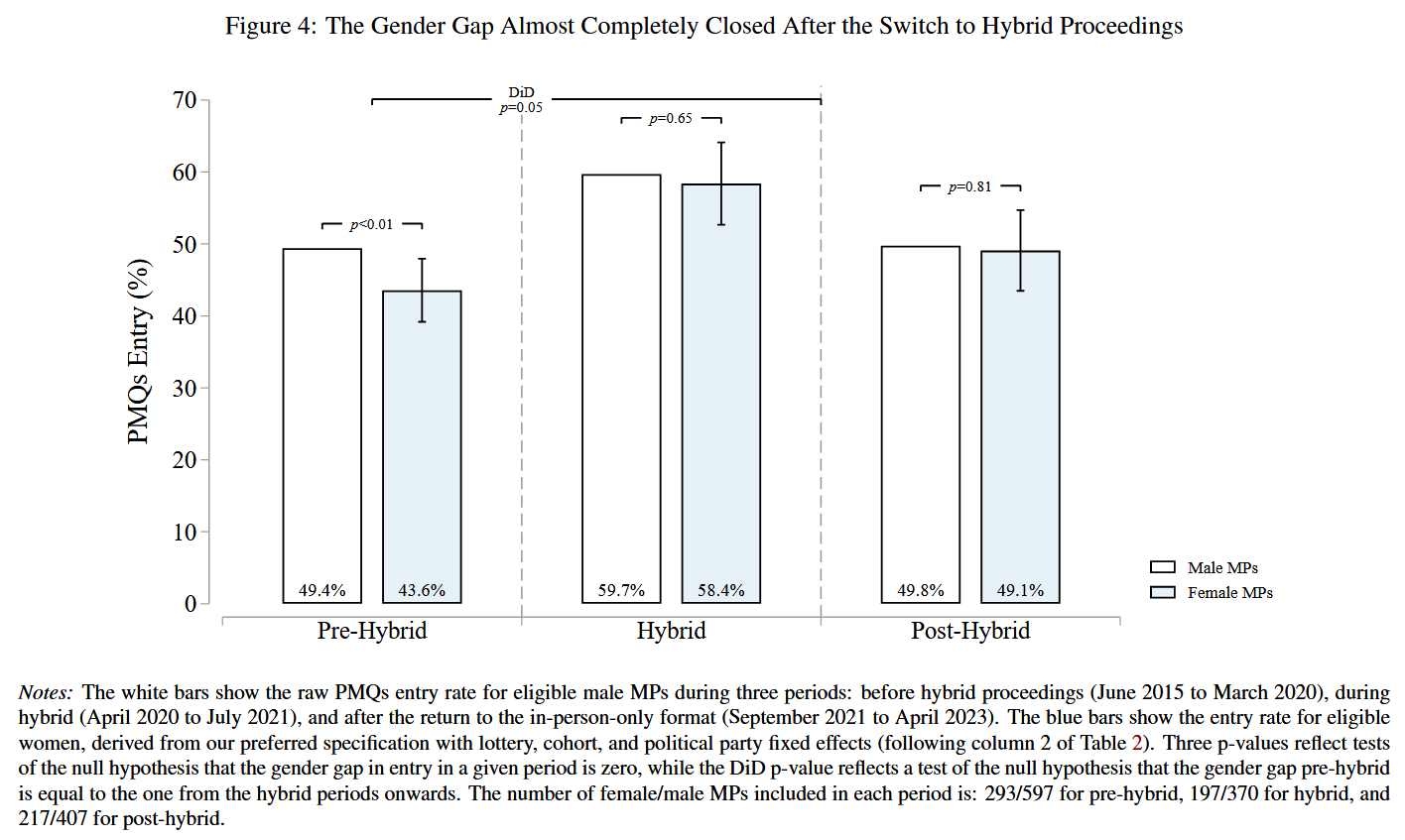
The gender gap almost completely closed with COVID switch to hybrid and has not returned even as the format has returned to normal
Key Table/Figure