Job Displacement, Family Dynamics, and Spousal Labor Supply

Job Displacement, Family Dynamics, and Spousal Labor Supply
Author: Martin Halla
Author: Julia Schmieder
Author: Andrea Weber
Abstract: We study the effectiveness of intrahousehold insurance among married couples when the husband loses his job due to a mass layoff or plant closure. Empirical results based on Austrian administrative data show that husbands suffer persistent employment and earnings losses, while wives’ labor supply increases moderately due to extensive margin responses. Wives’ earnings gains recover only a tiny fraction of the household income loss, and in the short-term, public transfers and taxes are a more important form of insurance. We show that the presence of children in the household is a crucial determinant of the wives’ labor supply response.
Date: October 2020
URL: https://pubs.aeaweb.org/doi/10.1257/app.20180671
Volume: 12
Pages: 253-287
Publication: American Economic Journal: Applied Economics
Issue: 4
Date Added: 11/2/2021, 8:55:30 AM
Reading Notes:
Objective: To measure the effect of a loss of employment from a plant closure or mass layoff of men has on their wives' labor supply and earnings
Importance: Gender norms can shape labor market outcomes. If women do not respond to a change in the labor market status, that reduces the insurance potential of marriage
Background: Most studies find small or no responses in wives' labor market participation and earnings when husbands lose their jobs. Families with children respond differently to income shocks than families without children
Data & Key Variables: Austrian administrative data - partners in marriages and divorces, plant closures, and mass layoff events
Methodology: Identify plant closures as last quarter plant employs workers. Mass layoffs must be reported in advance to employment office.
Event study with control group of non-displaced men with same age, job tenure, and marriage duration. Also control group of men working at same firm
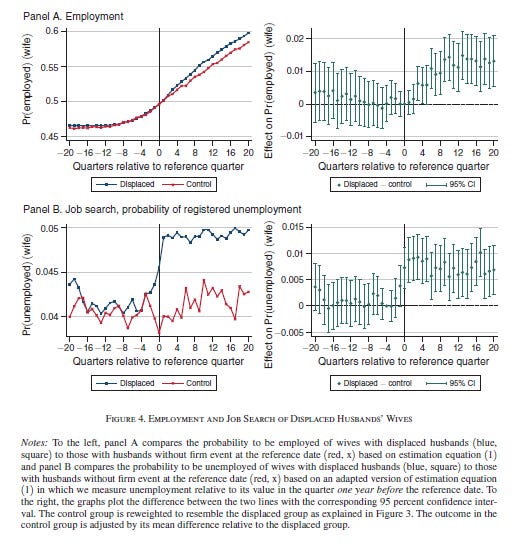
Results: Men experience large earnings and employment decreases at job loss, but their wives only increase employment by 1 percentage point and earnings by 2%.
The most responsive group are women with children ages 3-15
Note: Low female labor force participation pre-jobloss (50%)
Key Table/Figure: