Joint Child Custody and Interstate Migration
Authors: Abi Adams, Oğuz Bayraktar, Thomas H. Jørgensen, Hamish Low, Alessandra Voena
Abstract: Joint custody following divorce is widespread, but implementation is costly when individuals live in different states and so affects interstate mobility. Migration of separated fathers has fallen significantly more than that of married fathers. We show the causal effect of joint custody using two strategies. First, we survey separated parents to elicit beliefs about the likelihood of interstate moves. Second, we use the staggered adoption of joint custody laws across US states, and show a reduction in actual migration of 11 percentage points for fathers. For mothers, there is no impact on mobility but suggestive evidence of beneficial labor market outcomes.
Reading Notes
Objective
To understand the effect of joint custody laws on interstate migration, particularly migration of fathers
Importance
Although there is some research on geographic mobility of separated and single people, it is much more limited than work on families
This is the first paper to focus on the role of custody arrangements on that mobility
Background
The share of children not living with married parents has increase from 23% to 35% from 1980 to 2021.
Traditionally mothers retained sole custody in the case of divorce, but joint custody became more common starting in the 70s
Data & Key Variables
CPS ASEC - mobility of divorced and married men and women ages 21-65
Child Support Supplement (CSS) - characteristics of resident and non-resident parents and custody arrangements
PSID - divorced and separated respondents with children
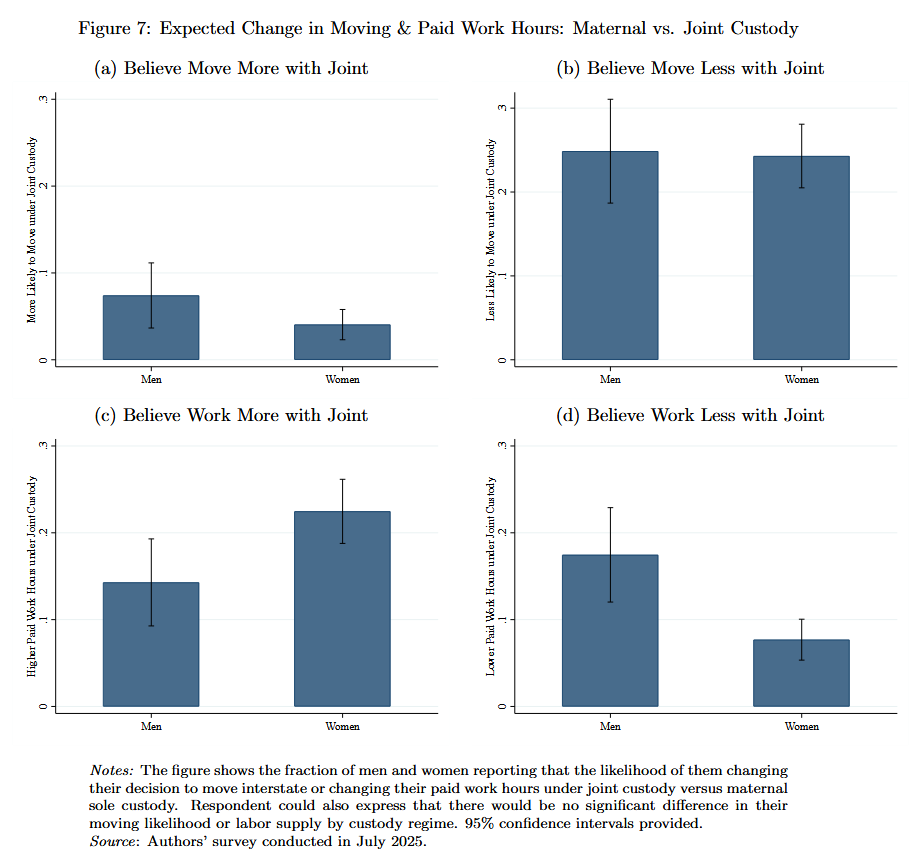
Custom survey of divorced parents - July 2025. 696 responses. Custody arrangement. Plans over next 3 years - probability of moving to another state, expected number of hours of paid work per week. Both under current custody regime and other (joint versus maternal sole custody)
Methodology
Diff in diff using staggered adoption of joint custody authorization across states using PSID data
Use custom survey to elicit beliefs over impact of joint custody
Results
Divorced men used to move more than married men, but their mobility rates have fallen faster, so now are about equal to the mobility of married men
Parents with joint custody are more likely to live in same state as children.
Parents expect that they would be more likely to move states under maternal sole custody than under joint custody
Joint custody laws reduce the migration of fathers over state lines by 12 percentage points, but have no effect on mothers
Key Table/Figure