Penalties in the Safety Net: Effects of Work Requirement Enforcement on Program Participation and Labor Supply

Penalties in the Safety Net: Effects of Work Requirement Enforcement on Program Participation and Labor Supply
Authors: Katherine Richard, Lea Bart
Abstract: U.S. cash assistance promotes self-sufficiency through employment but imposes penalties that reduce or remove benefit income when participants violate work requirements. This paper quantifies the downstream consequences of not meeting work requirements using novel administrative data covering the full caseload of Michigan's Temporary Assistance for Needy Families (TANF) program, combined with monthly enrollment records in the Supplemental Nutrition Assistance Program (SNAP) and Medicaid, as well as quarterly Unemployment Insurance earnings records. We study a policy reform that increased the length of time that families were removed from TANF after violating work requirements to estimate causal responses of long-term safety net attachment and labor supply. We find that penalties result in persistent enrollment declines in SNAP and Medicaid for all household members, even those still eligible for programs. Moreover, when penalties are made more severe, far fewer families re-attach to TANF and formal employment declines due to a decreasing rate of job entry. On net, labor supply responses do not offset lost benefit income, and harsher penalties reduce cumulative financial resources by an additional 84 percent over the subsequent two years. Our findings indicate that sanctions reduce broader safety net attachment and increase economic instability for vulnerable families over the long-term.
Seminar Notes
Venue
2025 Job Market Talk
Objective
To understand how safety net participation and labor supply respond to work sanctions and how increasing sanction duration affects this behavior
Importance
Estimates the effects of length of sanction, no whether or not there is a sanction. Also shows spillovers from sanctions in one safety net program to other programs
Background
Michigan policy reform 2011. Mandate 30 hours/week of work-related activities.
Violations result in sanctions of 3 months of account closure (no benefits received) for violation 1 and 2. 12 months of closure for violation 3+.
Increased to 3 months for violation 1, 6 months for violation 2, and lifetime closure for violation 3 in 2011.
Data & Key Variables
Michigan Administrative Data TANF recipients 2009-2019 - case composition and demographics, all violations of work requirements and associated penalties
SNAP and Medicaid monthly enrollment
Quarterly UI earnings
Sample period October 2009-October 2013
Methodology
Diff-in-diff comparing those who have been sanctioned two times, using variation in timing of second violation, which will change length of sanction from 3 months to 6 months
Triple diff using those with only 1 sanction as control group
Results
TANF work sanctions result in persistent reductions in TANF, SNAP, and Medicaid receipt.
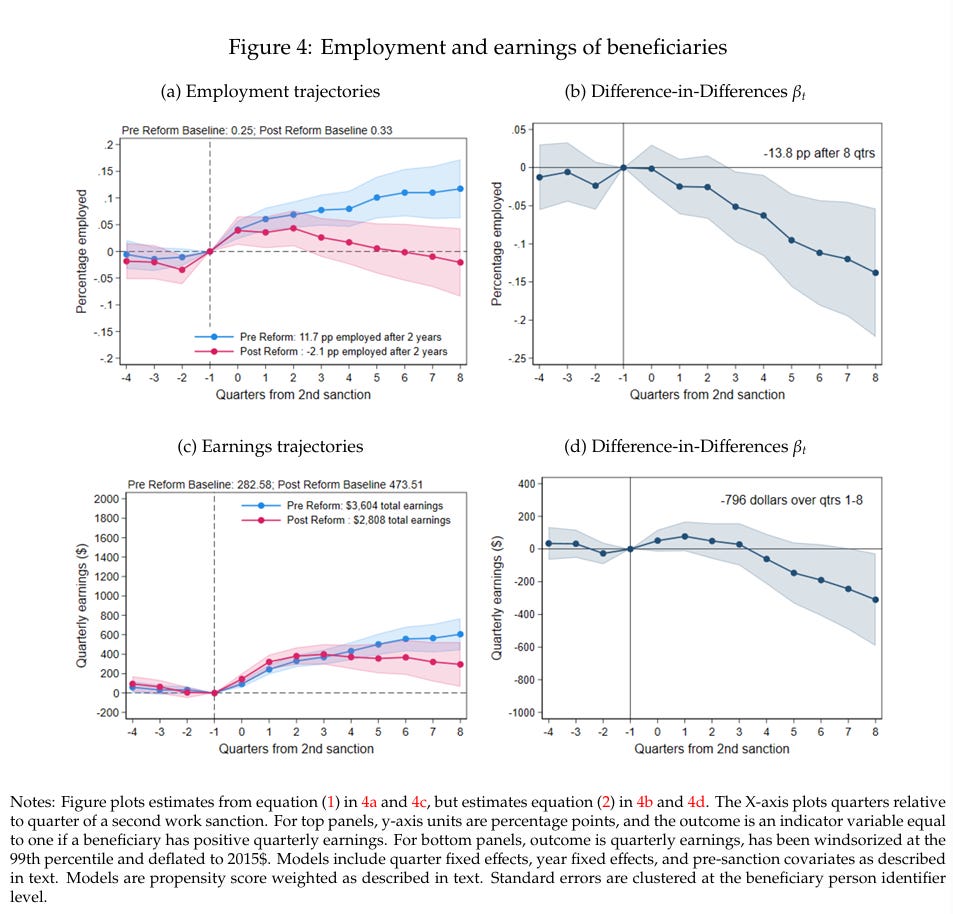
Labor responses do not offset lost benefit income, even among workers
Increase in sanction severely decreases formal employment by 13.8 percentage points, driven by lower job entry
Key Table/Figure