Statistical discrimination and the distribution of wages

Seminar Notes
Statistical discrimination and the distribution of wages
Authors: Prashant Bharadwaj, Rahul Deb, Ludovic Renou
Abstract: We characterize the conditions under which the wage distributions for two groups are consistent with a general model of statistical discrimination. We adapt this theoretical characterization to develop a novel empirical test, the rejection of which we interpret as evidence of taste-based discrimination. In doing so, we provide a theoretical foundation via which the wage structure effect in the decomposition of wage distributions can be interpreted as evidence of taste-based discrimination. We provide a proof of concept application using Census and NLSY-79 data, which suggests taste-based discrimination at work against Black male workers in several broad occupation categories.
Seminar Notes
Venue
ACLEC 2024
Objective
To understand how to determine if there is evidence of discrimination and, if there is, is it statistical or taste-based discrimination
Importance
Wage decomposition and statistical/taste-based discrimination have developed in parallel, but this paper shows how the two methods inform each other
Background
There are 2 groups or workers. A researcher observes wage distributions G1 and G2. There is a known set of productivity distributions for each set of workers.
Assume this set is one where average productivity is same across groups.
Employer receives signal S that is a noisy estimate of productivity
Data & Key Variables
5 year ACS - Men aged 30-55 working full time
Methodology
Ordered means - take group such as Black college-educated workers & White high school graduates.
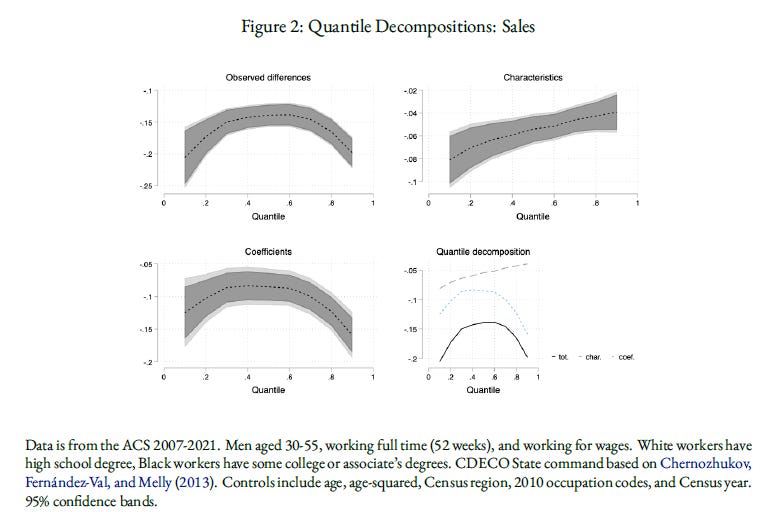
If White wage distribution first order stochastically dominates (FOSD) Black distribution in subsample, cannot be explained by statistical discrimination alone.
Results
White wages FOSD Black wages across distribution and variety of subsamples
Key Table/Figure