Structural Change and Jobless Development

Structural Change and Jobless Development
Authors: Franziska L. Ohnsorge, Richard Rogerson, Zoe Xie
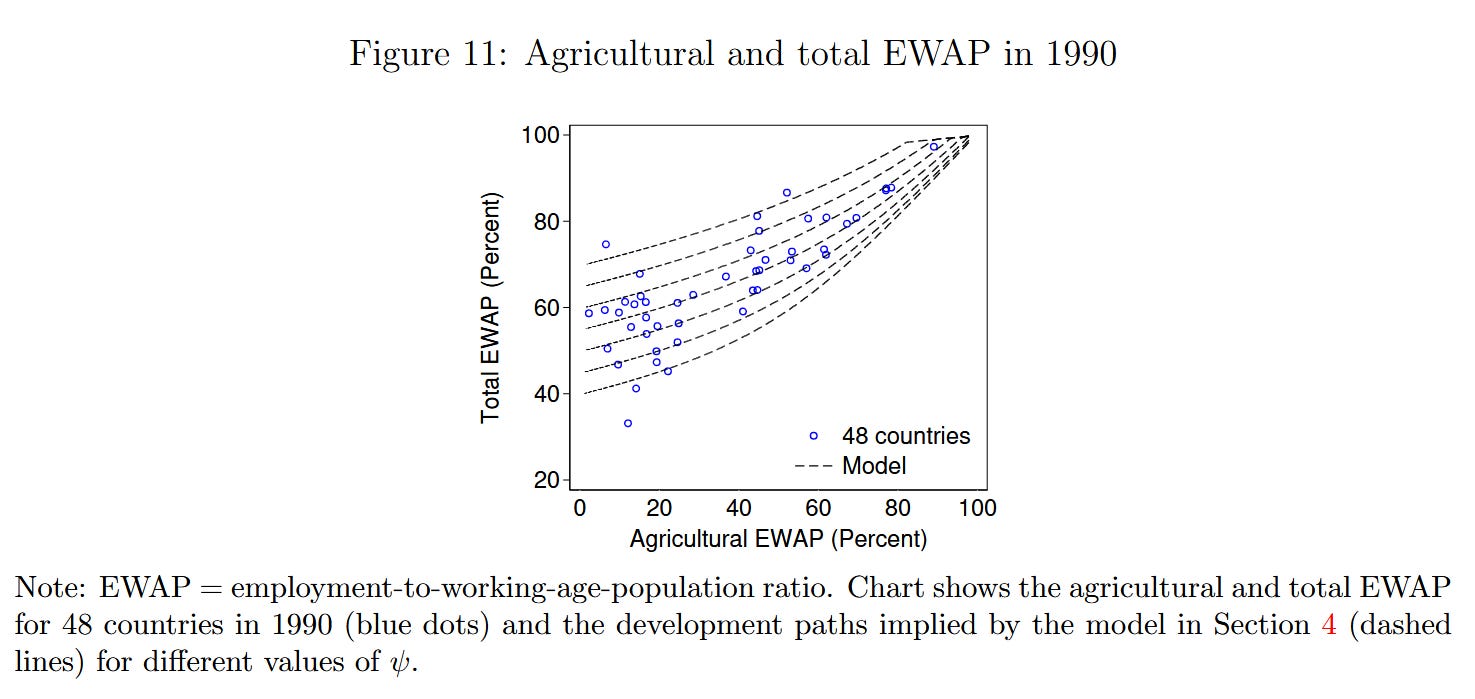
Abstract: Benchmark models of structural transformation focus on the reallocation of employment across sectors while assuming that overall employment stays constant. We show that this assumption does not match facts for developing economies. We study a panel of 48 mostly developing economies over the period 1990–2018 and document a strong positive relationship between the share of the population employed in agriculture and the overall employment rate. That is, the early part of the development process is associated with a substantial decline in the total employment rate. Motivated by this finding, we extend a benchmark model of structural change featuring Stone-Geary preferences to allow for endogenous labor supply. We show that this model can account for the patterns we document in the data both qualitatively and quantitatively. We use a calibrated version of our model to study the employment dynamics in several developing economies and show that structural change is a quantitatively important source of employment changes during the early stages of development.
Seminar Notes
Venue
BEA Seminar 2026
Objective
To describe the relationship between agricultural employment and total employment in levels and changes as countries develop and extend the theory of structural transformation to account for this relationship
Importance
Common features of models of structural transformation - multi-sector, non-homothetic preferences. Shift from employment in agriculture to non-agriculture.
If employment falls when productivity increases, welfare may go down
Background
Large differences in employment dynamics across countries as countries develop
Data & Key Variables
World Development Indicators, Employment Transformation database
Employment working age population ratio (EWAP) = Employment/Population age 15-64
Total EWAP = Non-agriculatural EWAP + Agriculatural EWAP
Labor productivity = PPP-adjusted real output/Employment
Balanced panel: 48 economies 1990-2018.
Unbalanced pre-1900: 29 economies 1960-1989
Methodology
Two-sector Stone-Geary structural transformation model with endogenous labor supply
When agricultural productivity goes up, less labor needed, income effect dominates in the short run and employment falls.
Eventually increases in non-agricultural productivity leads to rebalancing of income and substitution effects and convergence of employment rate
Results
There is a tradeoff between labor productivity and total employment (EWAP) as countries develop, driven by decline in agricultural employment. Total EWAP converges between countries as they develop
Labor wedge depends on productivity of agriculture - when subsistence needs dominate, wedge effects muted.
Lower labor wedge could counter employment declines: boosting female participation, lowering search friction
Key Table/Figure