The Opt-Out Continuation: Education, Work, and Motherhood from 1984 to 2012
Author: Tanya Byker
Abstract: Debate about an increasing trend in highly educated women dropping out of the labor force to care for children—an opt-out revolution—has been considerable. I use unique features of the of Survey of Income and Program Participation—a large nationally representative sample, longitudinal structure, monthly labor- force outcomes, and repeated panels—to study trends in women’s birth-r elated career interruptions over time and across the education spectrum. Methodologically, I use event studies to compare women’s monthly labor-force outcomes on the extensive and intensive margins from twenty-four months before to twenty-four months after births in the 1980s, 1990s, and 2000s. Rather than an abrupt change in opting out, I find that the pattern of birth-r elated interruptions has changed surprisingly little over the past thirty years—substantial and sustained interruptions remain common for mothers in all education categories. Rather than a revolution, I find an opt-o ut continuation.
Date: 2016
URL: http://www.jstor.org/stable/10.7758/rsf.2016.2.4.02
Accessed: 11/8/2021, 9:24:20 AM
Volume: 2
Pages: 34
Publication: RSF: The Russell Sage Foundation Journal of the Social Sciences
Issue: 4
Reading Notes:
Objective: To examine patterns in women's labor force participation before and after the birth of a child
Importance: Most other research on mother's labor force participation at the time was done with aggregate cross-sections or on specific sub-populations. This paper uses microdata to look at trends for a broad set of the U.S. population
Background: Belkin popularized the idea of an "Opt Out Revolution" amongst educated mothers, prompting lots of popular and academic discussion
Data & Key Variables:
SIPP 2008, 2004, 1996, and pooled 1984-1986 panels
Sample of women who gave birth during the survey period
Age 18-45
Education categories: <college, college, and masters+
Methodology:
Event study around month of first birth
Results:
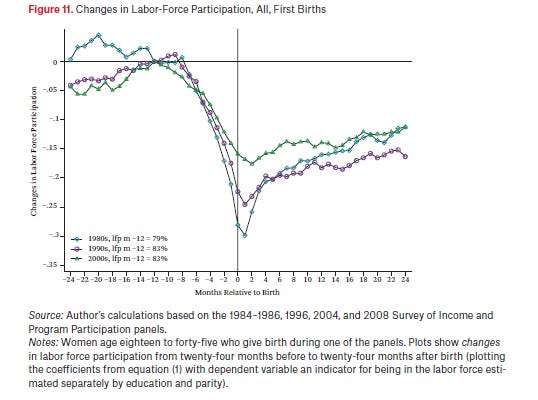
A substantial percentage (~14 percentage points) of women leave the labor force when they give birth. This has been consistent over 3 decades (1980s, 1990s, 2000s).
Married women opt out more than single women
Key Table/Figure: