The Work-from-home Wage Premium
Authors: Huiyu Li, Julien Sauvagnat, Tom Schmitz
Abstract: Using administrative data from France, we document that within the same detailed occupation, industry, and commuting zone, workers who work from home earn on average 12% higher hourly wages than fully on-site workers. Approximately half of this wage premium is accounted for by observable worker characteristics (such as education, gender, and age) and firm characteristics (such as size and productivity). The remaining 6% wage premium largely reflects selection: workers who work from home after the COVID-19 pandemic already earned higher wages before the pandemic.
Reading Notes
Objective
To understand the impact of work from home on wages and whether the WFH wage premium is driven by productivity or selection (either at firm or individual level)
Importance
Adds to the existing literature on WFH wage premiums by controlling for firm characteristics/firm fixed effects and pre-pandemic hourly wages of workers
Background
If WFH increases productivity, we would expect a wage premium from WFH unless 1) productivity gains are not passed on to workers or 2) the positive wage effect is offset by a compensating differential wage penalty from the amenity value of WFH
Data & Key Variables
French Labor Force Survey (Enquête Emploi en Continu) - whether and how much work from home, occupation, gender, place of residence. Sample: Age 18-70 who worked at least one hour during reference week. Post-pandemic (2022Q2 - 2024Q4)
Firm data (Fichier Approché des Résultats d’ESANE) - sales, employment, firm age, etc.
Social Security Records (Déclarations Annuelles des Données Sociales)- employment and wage history - pre-pandemic (2018-2019)
Link social security records and labor force survey via identifiers- date of birth, place of birth, gender, location of residence, employer
Methodology
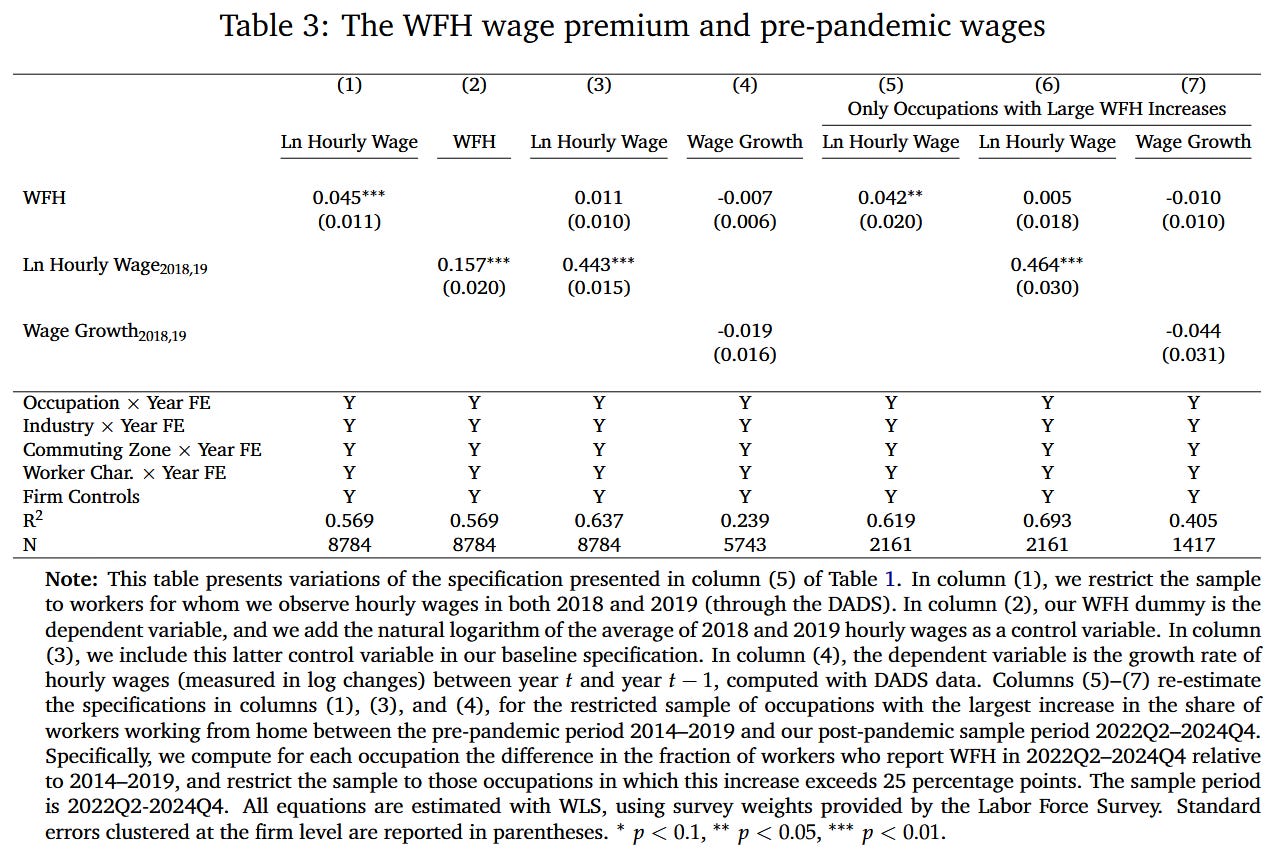
Regression of log wages on WFH status, progressively controlling for individual characteristics, firm characteristics/fixed effects, and pre-pandemic wages
AKM worker and firm fixed effects
Results
The post-pandemic wage premia of around 6.6% after controlling for worker characteristics is not explained by differences between firms, but is entirely explained by pre-pandemic wages and/or worker effects in an AKM framework.
High earning workers sorting into WFH seems to explain the WFH wage premium.
Key Table/Figure