Wealth Inequality and Labor Mobility: The Job Trap

Wealth Inequality and Labor Mobility: The Job Trap
Authors: Elena Pellegrini
Abstract: This paper studies how wealth affects workers’ ability to move to higher-paying jobs. Using microdata from the SIPP, I compare similar workers and find that those with higher liquid wealth are 35% more likely to change jobs than workers with no savings. To explain this pattern, I develop a job ladder model with incomplete markets, risk averse workers, and wage posting, where firms learn about match quality over time. Because firms gradually screen out workers in bad matches, changing jobs restarts the learning process and raises the risk of job loss. Workers with no liquidity, unable to insure against unemployment risk, prioritize job security over job mobility and remain trapped in low-paying jobs. This mechanism accounts for nearly 60% of the observed wealth gap in job mobility, and shutting it down yields both higher aggregate mobility and lower income inequality. More generous unemployment insurance offers a pathway out of the job trap: the optimal policy is hump-shaped in income and extends benefit duration to two years, raising welfare by an additional 25% relative to a model with constant layoff risk.
Seminar Notes
Venue
SEHSD Seminar 2026
Objective
To understand if differences in wealth affects workers’ ability to move to higher-paying jobs
Importance
Risk of losing job will be especially risk for those with low/no savings
Background
After changing jobs, workers typically see a 6-10% relative wage increase. Job loss risk declines with job tenure.
Changing jobs = higher wages but higher job loss risk
Data & Key Variables
SIPP - rich worker and job characteristics, ability to distinguish between voluntary and involuntary separation, and wealth data
Job to job transitions - voluntary separation, different employer identifier, no unemployment spell
1996, 2001, and 2004 panels (pre Great Recession)
Net liquid wealth: checking, savings accounts, stocks, bonds, securities - credit card debt
Net Illiquid wealth: Retirement, home equity - loans
Survey of Consumer Expectations - reservation wage, job search
Methodology
Job ladder model with incomplete markets and risk adverse workers. Novel mechanism for job ladder risk - wealth
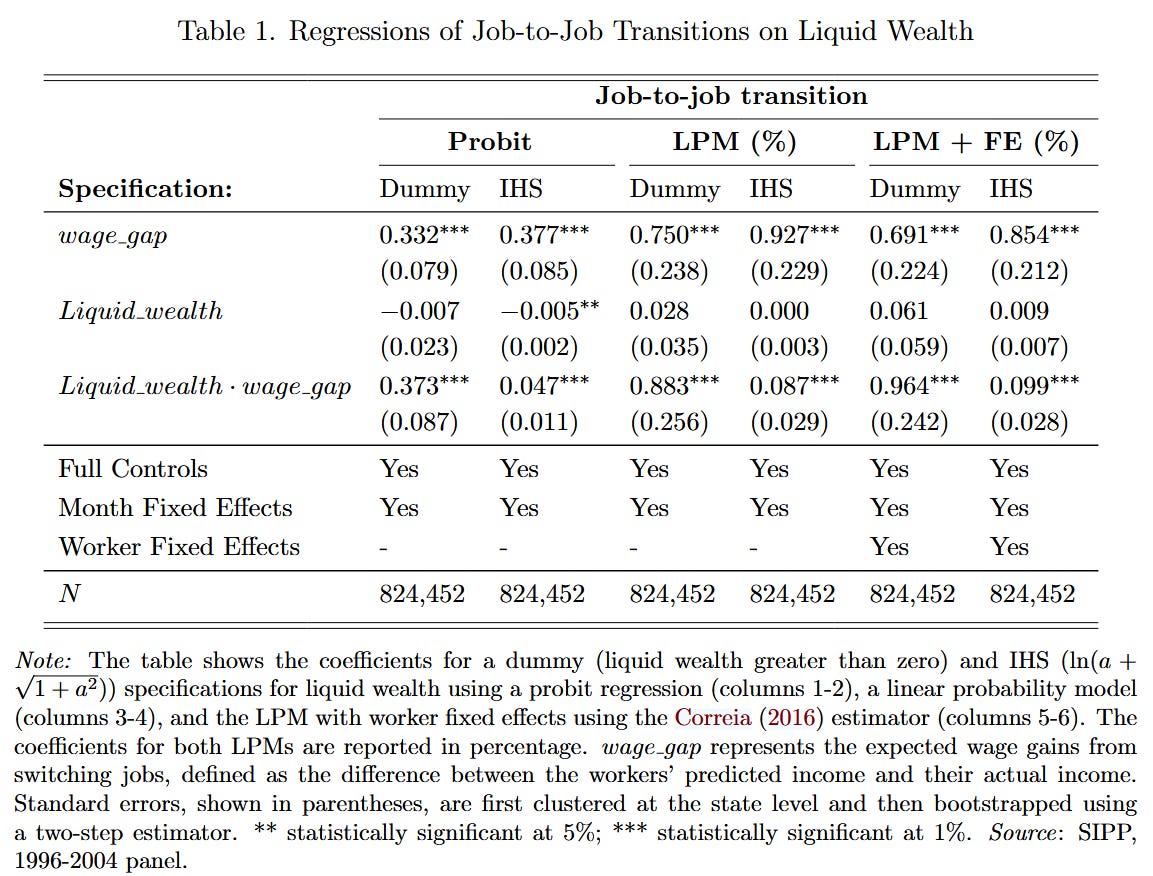
Estimate residual wages (predicted wage given characteristics). Gap between actual wages and residual wages is incentive to switch jobs.
Measure job switching on gap between actual and residual wages interacted with wealth
Results
Workers at the bottom of job ladder more likely to change jobs, but mobility is 35% higher for those with some liquid wealth. After job change, increase in wages
Wedge between reservation wages and actual wages for low-wealth workers.
Workers with no savings prioritize job security over job mobility
Key Table/Figure