Work from Home and Urban Structure
Authors: Matthew J. Delventhal, Eunjee Kwon, Andrii Parkhomenko
Citation: Delventhal, Matthew J. and Kwon, Eunjee and Parkhomenko, Andrii (2023). Work from Home and Urban Structure. Built Environment, 49(3), 503--524.
Abstract: The sustained increase in working from home in the wake of Covid has the potential to reshape the U.S. urban landscape. This article describes the big picture of pre2020 remote work in the U.S., and summarizes how that picture changed during the subsequent three years. It then introduces a mathematical model designed to calculate the possible long-run impacts of increased remote work on where and how Americans work and live.
Reading Notes
Objective
To understand how increases in working from home could reshape the urban landscape
Importance
This paper uses the model developed in Delventhal and Parkhomenko (2023) to predict changes to urban structure from increased WFH
Background
In 2019 5-10% of paid work days were conducted at home.
Tradable - goods and services that can be consumed far from where they are produced
Non-Tradable - goods and services that must be consumed close to where they are produced
Prior to COVID, hybrid arrangements rare (with hybrid defined as 1-4 full workdays worked from home)
Data & Key Variables
SIPP - at least one full day per week worked from home
National Household Transportation Survey - work from home and commute distance
Barrero, Bloom, and Davs (2021) statistics on WFH from representative surveys
Methodology
Model with three types of actors: workers who decide where to live and where to work based on wages, commute, and WFH ability; firms who decide where to offer jobs based on output price, real estate costs, and wages; and real estate developers who decide where, how much and what (commercial/residential) to build
Calibrate to match 2012-2016 data
COVID shock = reduction in stigma and organizational obstacles to remote work.
Results
Length of average commute will increase but average time spent commuting will decrease
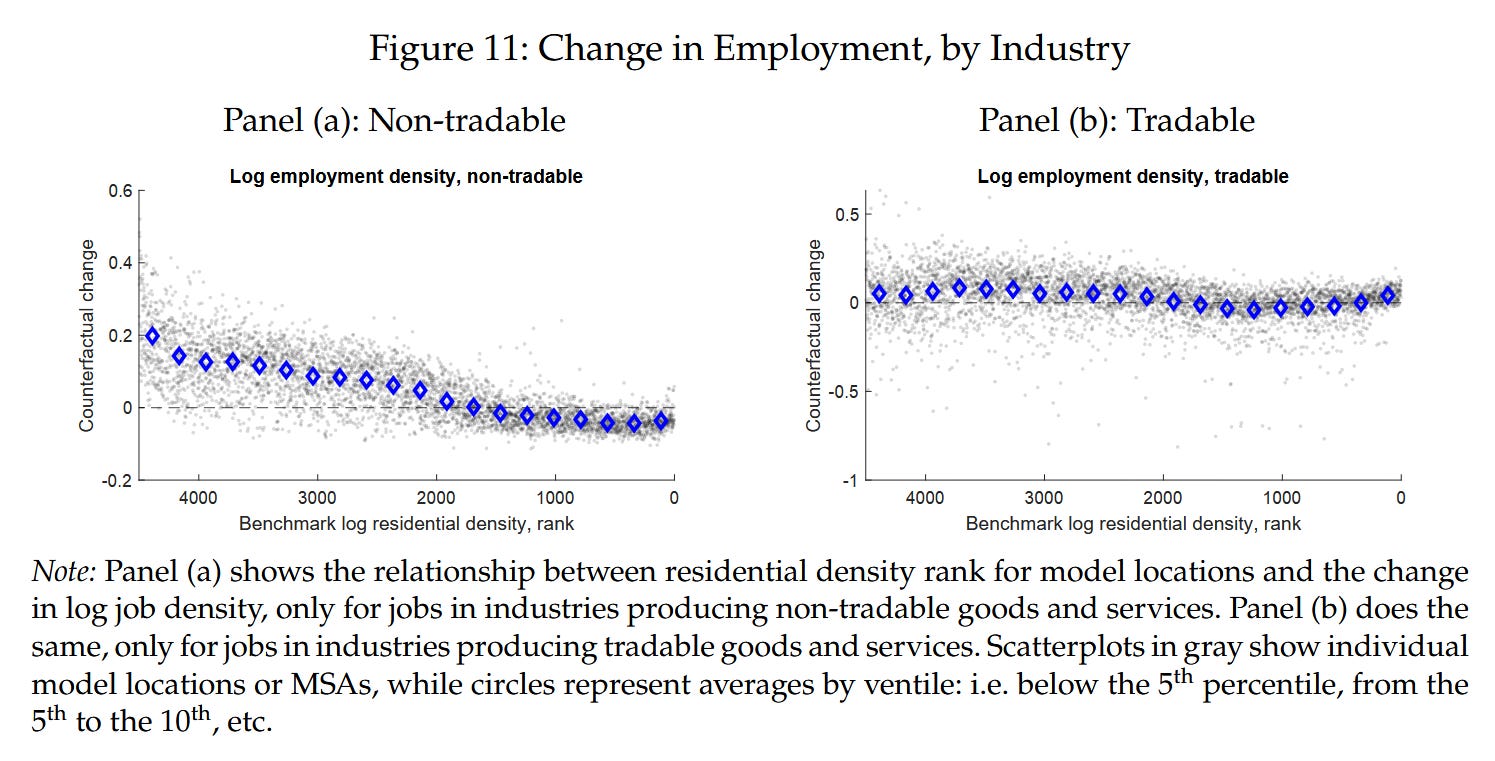
Jobs that produce nontradable outputs decentralize, following the population to the suburbs. Jobs that produce tradables either centralize more or decentralize to cheaper locations
Key Table/Figure